
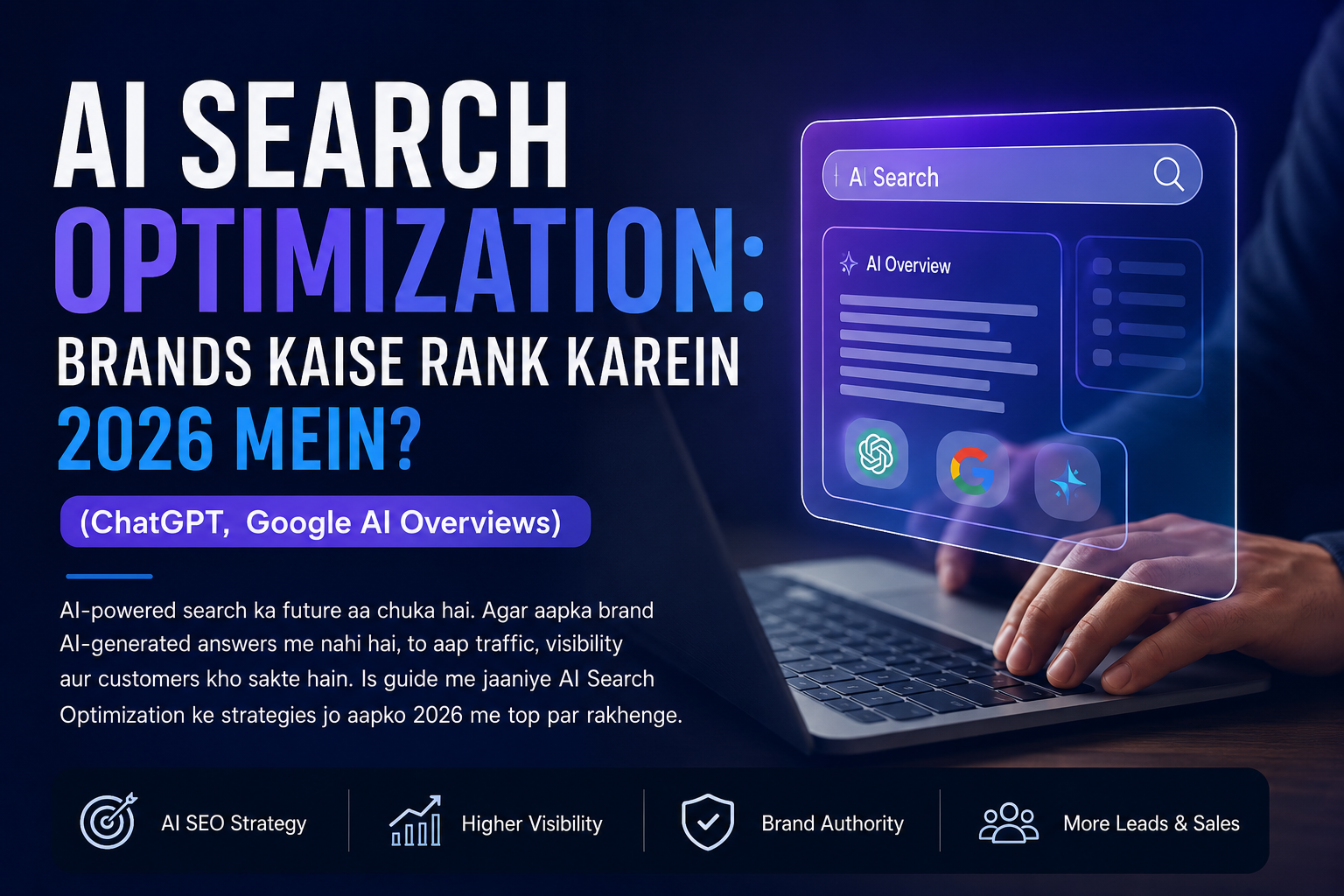
In this detailed guide, you will learn:
What AI Search Optimization means
How ChatGPT and Google AI Overviews choose content
Top ranking factors for 2026
The role of E-E-A-T and authority
How to create AI-friendly content
Common SEO mistakes brands are making
The future of AI-driven search
Whether you are a business owner, marketer, SEO professional, or agency, this guide will help you prepare for the next generation of search.
What is AI Search Optimization?
AI Search Optimization is the process of optimizing your content so that AI-powered search engines and answer engines can understand, trust, and recommend your website in generated responses.
Traditional SEO focused on:
Keywords
Backlinks
Meta tags
SERP rankings
Modern AI-driven search focuses on:
Context
User intent
Expertise
Trustworthiness
Structured information
Conversational relevance
This evolving approach is also known as:
Generative Engine Optimization
Answer Engine Optimization
AI systems no longer simply rank pages. Instead, they analyze content deeply and generate summarized answers using trusted sources.
How AI Search Works Differently
Traditional search engines displayed a list of links.
AI search engines generate direct responses.
For example, if someone searches:
“Best digital marketing strategy for local businesses in 2026”
Traditional search results:
- Show multiple website links
AI-powered search:
Generates a summarized answer
Combines information from trusted websites
Prioritizes authority and expertise
This means ranking alone is no longer enough. Brands must become trusted sources of information.
Traditional SEO vs AI Search SEO
Key Differences
Traditional SEO AI Search SEO Focus on rankings Focus on citations and authorityKeyword-heavy optimizationContext and semantic optimizationBacklinks dominate Trust and expertise dominate Click-based trafficZero-click answers increasingSearch result pagesAI-generated responses Static optimization Conversational optimization
GEO vs SEO
Understanding GEO vs SEO is essential in 2026.
SEO
Search Engine Optimization focuses on improving rankings in traditional search engines.
GEO (Generative Engine Optimization)
Generative Engine Optimization focuses on helping AI systems use and reference your content in generated answers.
SEO is still important, but GEO is becoming equally critical.
The best strategy is combining:
SEO
GEO
Brand authority
Structured content
How ChatGPT and Google AI Overviews Select Content
AI platforms do not choose content randomly.
They evaluate:
Trustworthiness
Content quality
Brand authority
Clarity
Relevance
Structure
Important AI Search Ranking Factors
1. Content Clarity
AI systems prefer content that is:
Well-structured
Easy to understand
Organized with headings and sections
2. Authority Signals
Strong authority indicators include:
Expert-written content
Author bios
Trusted backlinks
Brand mentions
Reviews and citations
3. Structured Data
Schema markup helps AI systems understand:
Page type
FAQs
Products
Reviews
Business details
4. Freshness
Updated content performs better because AI systems prefer current and relevant information.
5. Semantic Relevance
Modern AI search engines understand meaning, not just keywords.
Keyword stuffing is becoming ineffective.
6. Intent Matching
AI systems evaluate whether your content directly solves the user’s problem.
Content that answers questions clearly has a better chance of being cited.
Google AI Overviews SEO Explained
Google AI Overviews summarize information from multiple trusted sources directly within search results.
Google AI Overviews generally prioritize:
Authoritative websites
FAQ-rich content
Structured articles
Trusted publishers
Expert-driven insights
Because of this, Google AI Overviews SEO is now a dedicated optimization strategy.
Brands must focus on becoming trusted information sources rather than simply chasing rankings.
Why ChatGPT SEO Matters
More users are now using AI assistants for:
Product research
Business recommendations
Comparisons
Learning
Service discovery
This makes ChatGPT SEO increasingly important.
If AI assistants never reference your brand, your visibility may decline over time.
The goal of ChatGPT SEO is to ensure that your brand:
Appears trustworthy
Publishes high-quality information
Builds authority in its niche
Creates structured and accessible content
Top Ranking Factors for 2026
1. Topical Authority
Brands must demonstrate deep expertise in their niche.
For example, a digital marketing agency should not only publish one SEO article.
It should also cover:
Technical SEO
Local SEO
AI SEO
Content marketing
Voice search optimization
Conversion optimization
Topical depth improves trust signals.
2. Entity-Based SEO
Search engines increasingly understand entities rather than keywords alone.
Entities include:
Brands
People
Products
Locations
Services
Consistent branding across:
Website
Social media
Business listings
Blogs
PR mentions
...helps strengthen entity recognition.
3. Conversational Content
AI systems prefer natural language.
Bad example:
“Affordable best SEO agency Delhi cheap SEO services.”
Better example:
“Businesses looking for affordable SEO services in Delhi should focus on long-term growth strategies instead of short-term ranking tricks.”
Natural writing improves AI understanding.
4. Real Experience Content
Generic AI-generated content is becoming less effective.
Search engines increasingly value:
Real-world examples
Case studies
Original insights
Personal experience
Data-backed observations
5. Multi-Format Content
The future of search is multimedia-driven.
Brands should invest in:
Videos
Infographics
Podcasts
Webinars
Visual explainers
AI ecosystems analyze multiple content formats for authority signals.
E-E-A-T and Brand Authority
Google’s E-E-A-T framework plays a major role in AI SEO.
E-E-A-T Means:
LetterMeaningEExperienceEExpertiseAAuthoritativenessTTrustworthiness
How Brands Can Improve E-E-A-T
Add Real Author Profiles
Use real authors with expertise.
Publish Original Insights
Share:
Case studies
Industry analysis
Client experiences
Research findings
Build Brand Trust
Trust signals include:
Reviews
Testimonials
Media mentions
Consistent branding
Keep Information Updated
Outdated information weakens authority.
Regularly refresh:
Statistics
Trends
Guides
SEO strategies
Structured Data & Schema Markup
Structured data helps search engines understand your content more effectively.
Schema markup improves:
AI interpretation
Rich snippets
Content categorization
Search visibility
Important Schema Types
Schema TypePurposeFAQ SchemaQuestion-answer contentArticle SchemaBlog structureLocal Business SchemaBusiness visibilityProduct SchemaEcommerce optimizationReview SchemaTrust indicators
Why Schema Matters for AI Search
Schema helps AI systems:
Extract answers faster
Understand context
Generate accurate summaries
Improve visibility in AI responses
For Answer Engine Optimization, schema markup is highly valuable.
How to Create AI-Friendly Content
1. Target User Questions
Use “People Also Ask” style questions throughout your content.
Examples:
What is AI Search Optimization?
How does ChatGPT SEO work?
What are AI Search Ranking Factors?
2. Use Short Paragraphs
Readable content performs better for both users and AI systems.
3. Structure Content Properly
Use:
H2 headings
H3 headings
Bullet points
Tables
FAQ sections
Structured content improves crawlability.
4. Use Semantic Keywords Naturally
Include relevant phrases such as:
AI SEO Strategy 2026
Generative Engine Optimization
Google AI Overviews SEO
AI Search Ranking Factors
Avoid forced keyword repetition.
5. Give Direct Answers
AI-generated summaries often prefer concise, direct explanations.
6. Add Statistics and Trends
Data-backed content builds credibility.
Industry trends show:
AI-assisted search usage is growing rapidly
Zero-click searches are increasing
Users increasingly prefer conversational search experiences
Common Mistakes Brands Are Making
1. Keyword Stuffing
AI systems can easily detect unnatural optimization.
2. Thin Content
Short, low-value articles are becoming ineffective.
3. Ignoring Brand Authority
Anonymous content often struggles to gain trust.
4. No Schema Markup
Ignoring structured data reduces AI visibility.
5. Publishing Unedited AI Content
Pure AI-generated content without human expertise often lacks depth and originality.
6. Weak Content Clusters
Single isolated blogs rarely build strong topical authority.
Future of AI SEO
AI-driven search is still evolving rapidly.
Major future trends include:
1. Personalized AI Results
Users will increasingly receive customized AI-generated answers.
2. Voice + AI Integration
Voice search and AI assistants will become deeply connected.
3. Visual Search Expansion
Image-based and multimodal search will continue growing.
4. Brand Mentions Will Matter More
Brand reputation may become more influential than backlinks alone.
5. AI Agents Will Influence Purchases
Future AI systems may recommend products and services based on:
Trust
Reviews
Brand authority
User satisfaction
People Also Ask
What is AI Search Optimization?
AI Search Optimization is the process of optimizing content for AI-powered search engines and answer platforms.
What is the difference between GEO vs SEO?
SEO focuses on traditional rankings, while GEO focuses on visibility inside AI-generated answers.
Why is ChatGPT SEO important?
Because AI assistants are becoming a major source of information discovery and recommendations.
What is Google AI Overviews SEO?
It is the practice of optimizing content for inclusion in Google’s AI-generated summaries.
How can I create AI-friendly content?
Use structured formatting, semantic keywords, FAQs, expert insights, and conversational language.
FAQs
1. Is traditional SEO dead?
No. Traditional SEO still matters, but AI optimization is becoming equally important.
2. Can AI-generated content rank?
Yes, but human editing, expertise, and originality are essential.
3. Is schema markup necessary?
It is not mandatory, but highly recommended for AI visibility.
4. Can small businesses benefit from AI SEO?
Absolutely. Niche expertise and local authority can help small brands compete effectively.
5. What is the most important AI Search Ranking Factor?
Trustworthy, useful, and well-structured content.
Internal Linking Suggestions for Techpotli Digital
You can internally link this article to:
AI in Digital Marketing 2026
Local SEO Services
Technical SEO Services
Social Media Marketing Guide
Content Marketing Strategy
Google Business Profile Optimization
Conclusion
The future of digital visibility is no longer limited to traditional search rankings. AI-powered search systems are transforming how users discover brands, services, and information.
AI Search Optimization is no longer optional.
Brands that want to succeed in 2026 must focus on:
Authority
Trust
Helpful content
Structured information
Conversational experiences
The businesses that adapt early will gain a major competitive advantage in the evolving AI search ecosystem.Companies that continue relying only on outdated SEO tactics may struggle to maintain visibility as AI-generated answers become the new standard.The future belongs to brands that build genuine expertise, publish valuable content, and optimize for both humans and AI systems.